Sunday, June 21, 2009

Friday, June 05, 2009

200 years that changed the world

A perfect illustration of how a well-made graphic can aid in the comprehension of an intricate subject. I came across this clip on NPR.org's Planet Money column. It's the coolest YouTube clip I've seen in awhile, not counting the world's first DJ battle.


Once you've viewed the clip, go to the Gapminder website to play with the graph yourself, and to create or view others. Keep in mind, however, that historical data on these statistics, especially prior to 1900, is sometimes spotty and that many of these figures are estimates.

Monday, May 11, 2009

The Path Behind Me

In April of 2005, I posted a blog with pics detailing how and why I sent a sample of my DNA into the Genographic Project for Y chromosome analysis. Roughly four years later, I realized while going over the paperwork with my dad that I've never shared the results.

This is the story of my forefathers, and possibly yours as well.
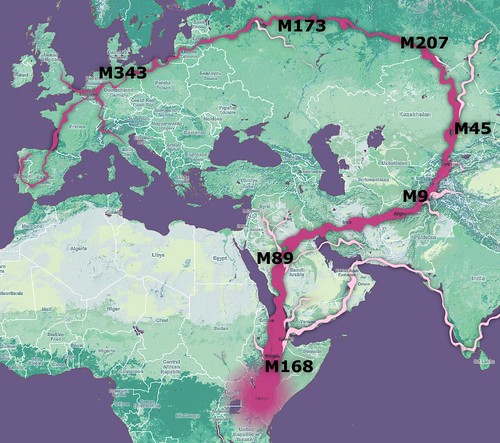
The path behind me

Once upon a time in the Stone Age -- about 60,000 years ago -- there lived a man who became the common ancestor of the vast majority of humans alive today. Since Christians believe that the name of the primogenitor of humanity was Adam, let's call this man the "Eurasian Adam" (though he certainly wasn't the first "man" or even the only man alive at the time). He was, however, the progenitor of all non-African people; we know this is true because we all carry his genetic marker, known as M168, in our DNA: indigenous Australians, Asians, Native Americans, and Europeans -- and most Africans as well. This "Eurasian Adam" lived in eastern Africa, where he fathered children and grandchildren, and it was his descendants who became the only lineage of humanity to endure outside of our home continent. In Europe and Asia, where Neandertals and Homo erectus thrived for millennia but ultimately died out, Homo sapiens would survive.

The first wave of modern humans emigrated from Africa soon after the M168 genetic marker appeared. They likely followed a coastal route around the future Arabian peninsula, the Indian subcontinent and southeast Asia. Sea levels were much lower due to the ongoing glacial period, and the channel between the land masses that would become Indonesia and Australia was only 90 kilometers wide; easily conquered by a nomadic people who had made their living along the maritime coast for a few centuries, or perhaps millennia. They crossed that gap and survived in their new homeland for 40,000 years, eventually to become known to western explorers as the indigenous Australians. These were not my ancestors.

Other descendants of the "Eurasian Adam" later migrated northward from their birthplace, probably following herds of animals moving in that direction during the temporary retreat of the glaciers that brought a moister climate to the African deserts. About 45,000 years ago, in northern Africa or the Middle East, one of these descendants fathered a male child with a different genetic marker, M89: riding the crest of the second wave of migration out of Africa, he was to become the ancestor of about 92% of all non-Africans alive today. Within the next few thousand years the climate shifted again and the grasslands retreated, rendering the great desert to the south impassable once more. Some of M89's descendants remained in the Near East; others migrated to the northwest, toward the Mediterranean; still others followed the animals that roamed ever north and east, to the steppes of Central Asia. Let us follow this latter group, because they are my ancestors, and probably yours as well.

The next branch in this family tree is a mighty one. Roughly 40,000 years ago, one of M89's descendants was born with another genetic marker, M9. This man, born in present-day Iran or south central Asia, was to be the ancient ancestor of almost all North Americans and East Asians, as well as most Europeans and many Indians. His descendants populated most of the northern hemisphere. Over the next few millennia, tens of thousands of people dispersed to the east and north. When they encountered the Pamir Knot, the junction of four behemoth mountain ranges that is sometimes called "The Roof of the World", some moved south while others continued north, spawning new separate genetic lineages.

We will follow the line that went north into central Asia. Roughly 35,000 years ago, when there were approximately 100,000 human beings on the planet (not counting the Neandertals still living amongst the glaciers in present-day Europe) the next link in the chain appears: M45. He lived in central Asia in the way of his ancestors, by gathering edible vegetation and by following and hunting the mammoth, bison, and antelope herds. But soon the climate shifted once more, and the expanding glaciers and reduction in rainfall may have forced the animals to abandon the southern steppes and push northward once again, with the humans trailing as always. The harsher climatic conditions may have helped spark new hunting techniques for the larger animals encountered in the north, and new technology like bone needles for sewing clothes made from animal skins. From here, some people went northeast -- this branch eventually settled east Asia, and included the ancestors of the small group who would migrate across Beringia and work their way south to become the natives of both North and South America. But my ancestors did not walk east.

The M207 genetic marker appears in a man who lived roughly 30,000 years ago, as a branch of the Central Asian clan moved west. Soon afterward, another marker appeared in my bloodline, M173. Some of his descendants would reverse their trajectory and descend southeast, some in due course making it all the way to the Indian subcontinent. But my ancestors forged ahead into Europe, part of the first wave of modern humans to do so, and survived to see the extinction of our hominid cousins, the Neandertals.

Homo neanderthalensis had been living in Europe for roughly a quarter million years, ages before our ancestors began their journey out of Africa. We did not evolve from them, but we shared a common ancestor some 500,000 years ago. They were intelligent, social hominids, and they exhibited altruism in caring for their young, sick, and elderly. They buried their dead in what some archeologists consider ritualistic fetal positions, which may be evidence for religious belief. They made tools and were well adapted to their environment, which was again changing; this time, however, they had competition.

The descendants of M173, known to archeologists as the Aurignacian culture, brought with them the technology they had developed in central Asia: tools and weapons made of stone, bone, ivory, antler, and shells. They carved figurines and wore jewelry, a possible indicator of status within the clan and a more complex society. They also possessed better techniques for communication, and they had the resourcefulness that had served them so well throughout their migrations. There was probably some form of contact between my ancestors and their much older European cousins, but there is no genetic evidence that interbreeding took place between the two species. Within the span of a few thousand years, the Neandertals were extinct.

At around this same time, one of M173's descendants sired the last known link in this chain: the man carrying the genetic marker known as M343, the defining marker of genetic Haplogroup R1b, of which I am a member. My ancestors were once known as the Cro-Magnon people, but today anthropologists prefer to call them Early Modern Humans. They wove clothing, lived in huts, made and played primitive musical instruments, and painted unprecedented depictions of wildlife in caves in southern France.

About 20,000 years ago, the Last Glacial Maximum brought ice sheets again down into the British Isles and northern Europe; to avoid the oncoming glaciers, my ancestors moved south into the Iberian peninsula, Italy, and the Balkans. About ten thousand years later, the last glacial period ended, allowing M343's descendants to repopulate northern Europe, where they thrived and eventually gave up hunting and gathering for agriculture and animal domestication. These innovations allowed for larger populations, and greater hierarchical differentiation within those populations. Clans and tribes became villages and towns. Over the course of thousands of years polytheistic religions took shape and were in turn displaced by southeastern monotheism; languages grew apart through geographical isolation; conquerers brought other foreign tongues; cities sprang up and were destroyed and rose again; in short, the beginning of recorded history was made.

Today, descendants of M173 can be found all over western Europe, with concentrations highest in northern France and the British Isles, where the marker was carried after populations had hidden from the glaciers in Spain and Portugal. I share my own haplogroup, R1b (defined by the presence of genetic marker M343), with about 70 percent of men in southern England. R1b is even more prevalent in parts of Spain, France, Scotland and Ireland, where it is carried by more than 90 percent of the male popuation. My family knows that my father's paternal heritage is American of northern European ancestry; when we delve back a few hundred years, however, the knowledge of our history dissolves into myth. We do not know for certain why my paternal ancestors left Europe for America, or even from which country they came. On which side did they fight in the Hundred Years' War? Were they aggressors or victims in the Norman invasion of England? On what chalky coast or in what verdant hinterland did they weather the Dark Ages and the Black Death? I'll never know the answers to these questions.

I find it astounding and humbling that the ancient origins of my forefathers, going back tens of thousands of years, can now be known with greater certainty than the relatively recent past. I am grateful to modern science for enriching my life and for telling me the story of my ancestors.

I wrote this blog entry with the aid of materials I printed out from The Genographic Project's website, and made the above graphic using Google Maps and Shake. Click here, here, or here to see the maps and test results of others who have submitted their DNA to the Genographic Project.

Sunday, March 15, 2009

Tilt-Shift Piracy

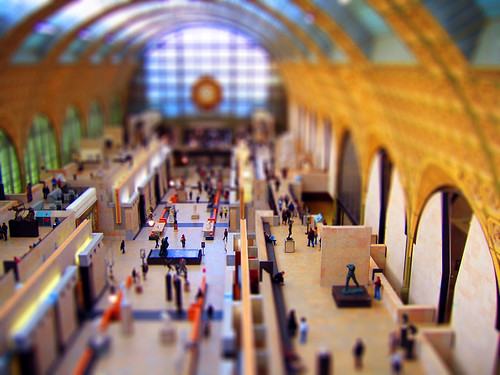
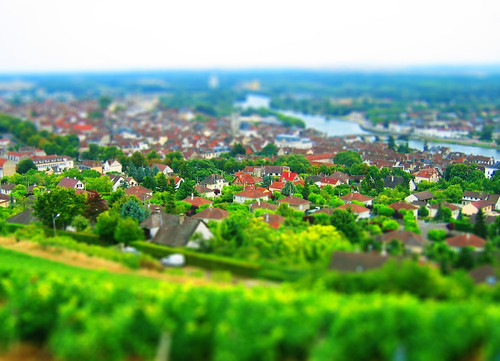
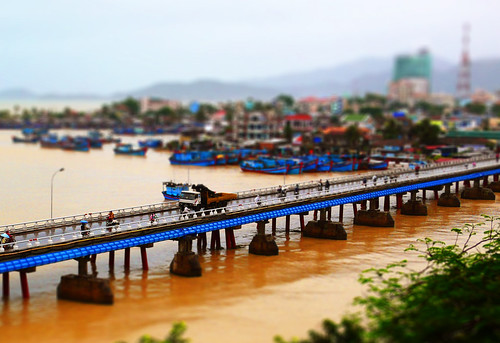
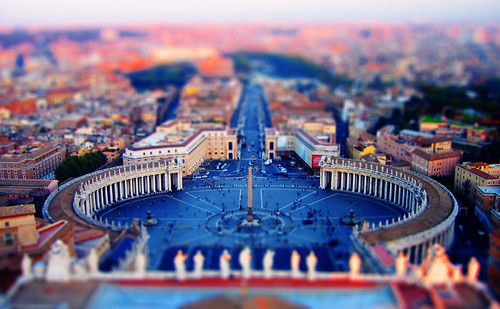
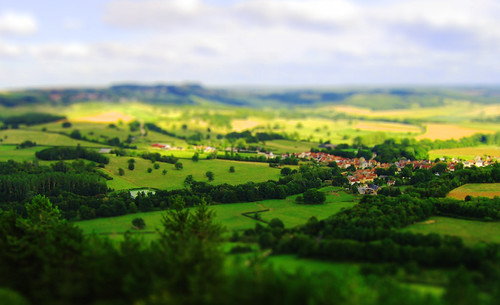
Last week my friend David brought my attention to some online examples of tilt-shift photography, along with some faked tilt-shift miniature photographs. My interest was piqued enough by the counterfeits to attempt my own forgeries; below are the results. These photos were taken (by me) with either a Canon S500 or a Panasonic DMC-LX2 and post-processed using Photoshop, to make them look like miniatures photographed with a macro lens. Click on a pic for more information on the location, to see the original unretouched image, or to view a larger size.

Miniscule Musée d'Orsay

Lilliputian Joigny

Petite Paris

Pint-sized Shek O golf course

Little Xom Bong Bridge

Pocket-sized Saint Peter's

bijou Burgundy

Saturday, March 14, 2009

Dubai-bye?


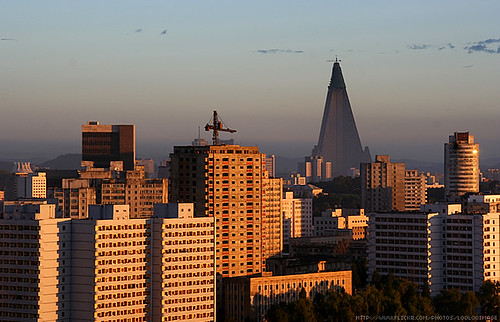
Annyeonghaseyo, Pyongyang, originally uploaded by Looloo~*.

In 1987, the North Korean regime began work on what was supposed to become the world's tallest hotel -- the 330 m (1,083 ft) Ryugyong Hotel in Pyongyang; but it was not to be. When work was halted in 1992, it already ranked as the ninth tallest skyscraper in the world by roof height, almost exactly the same roof height as the Empire State Building. Though the superstructure was complete, lack of funding and faulty construction methods forced the abandonment of Ryugyong. For 16 years the mountainous shell of the hollow structure loomed over the North Korean capital, looking more like a jagged, decaying megalodon tooth than a hotel. Construction was resumed in April 2008 for a planned 2012 completion, and recent photos show newly installed windows on the concrete face. Windows and fittings, however, can't hide the fact that while the original plans called for a structural steel frame, that proposal was apparently rejected for its expense; according to Wikipedia, the skyscraper was built entirely out of cheaply made reinforced concrete.

In 2004, construction began on the Burj Dubai, the tallest man-made structure ever built. Its superstructure was completed in January of 2009, and it is over twice as tall as the roof height of the Empire State Building. But the recent worldwide economic collapse has smashed Dubai's bubble. In January 2009 prices in the tower fell by 50%, from a high last June of around $4000 per sq ft, a drop that is typical of other properties in the emirate. Debtors are apparently leaving Dubai in droves, abandoning their luxury automobiles at the airport. Could Dubai become the world's tallest ghost town? Will the Burj Dubai become the new Ryugyong Hotel? Click the video below to watch a CBS News report on the Dubai real estate situation:


Click here to see Skyscraperpage.com's diagram of the what world's tallest buildings will be next year: Burj Dubai is #1, of course, whether it's occupied or not; Taipei 101 -- currently the world's tallest skyscraper -- is #3; Chicago's Sears Tower (the tallest American skyscraper and former world record holder from 1974-1998) comes in at #9; The Empire State is way over on the right at #19.

Incidentally, it was announced on Thursday that the name of the Sears Tower will change to Willis Tower this June, after London-based Willis Group Holdings. A sign of the times, I suppose; the Chrysler Building, that most elegant of Manhattan's Art Deco skyscrapers, was bought last year by the Abu Dhabi Investment Council.

Monday, February 16, 2009

Happy Presidents' Day

George Washington trivia: "He had a wig for his wig and a brain for his heart..."

Tuesday, February 10, 2009

Tantum religio potuit suadere malorum, part II

"So potent was religion in persuading to evil deeds" -- thus wrote Lucretius. I will go even further:

Tantum religio potuit suadere ignorantia

"So potent was religion in persuading to ignorance". As evidence, I give you this image:


When I found the above Google search screen capture on Digg today, I didn't believe it. Then I tried it myself (it's accurate), and even tried a different search, including Darwin's given name:


It's a sad comment on the current lack of science education in our country, as well as on the dearth of skepticism and critical thinking skills in ye surfers of the internet. This is especially poignant given the fact that in exactly two days we will be celebrating the 200th anniversary of the birth of this immensely important scientist.

Happy birthday, old chap! Terribly sorry, but it appears that your rigorously tested and eminently sound theory of Evolution, which remains uncontested in worldwide scientific literature, has fallen quite out of favor with the ignorant yet self-righteous lay public in these United States of America. A pity, that -- this country being such a technological marvel of the modern age, as well as the last superpower and all. Regrettably, two of our greatest super powers are ignorance and religiosity...always a bad combination.

Sunday, February 01, 2009

Tim Minchin

My new favorite song:


I only just discovered this "huge rock n roll megastar" today, courtesy of the Skeptics' Guide to the Universe.

Friday, January 30, 2009

Kogi Korean BBQ To Go


street life taco style-68, originally uploaded by kogibbq.

Last night I decided it was time to sample L.A.'s newest gastronomic fad, marinated and barbecued Korean meat wrapped in tacos and sold from a truck. It was actually Dnice, recently transplanted from the east coast, who educated me on the fusion street fare after hearing about it on Good Food last weekend.

As ludicrous as it sounds, I stood in a line of over a hundred food fiends on Wilshire and Cloverdale for 90 minutes. After the first 20 I was committed; I had made the effort to drive out to the Miracle Mile at 22:00 on a school night, and anyway all I had at home was cereal and milk. Luckily I had the latest Radiolab podcast to keep me company, and at around 23:30 I finally got to have my photo taken and place my order for 3 tacos -- tofu, spicy pork, and spicy BBQ Chicken.

The tacos were delectable -- beautifully textured toppings wedded flawlessly with the tangy, spicy meat; the overall mouthfeel was pinguid and yet perfectly crisp. As my friend Tom pointed out today, however, nothing short of ambrosia could fully satisfy after an hour and a half in the cold, but Kogi came close -- it could very well be the late night drunk food of the gods.

I can't wait for the fad to pass so I can get this toothsome treat without the long wait.

Sunday, January 25, 2009

Deconstructing Religious Violence

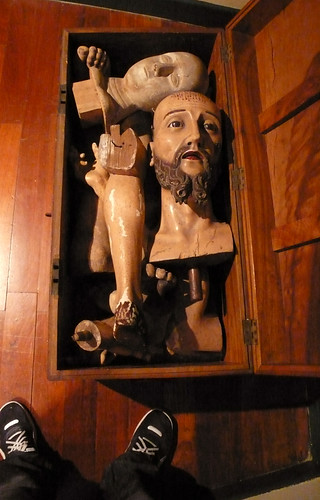
Take a look inside --

I just read The Rumpus Long Interview with Steven Soderbergh. Near the end, the director begins to lament what little effect film actually has on society's problems, and he makes a particularly insightful statement:

Any discussion about the Middle East that doesn’t start with whether monotheism is a good thing or a bad thing is an irrelevant discussion. This is all based on the fact that some people think that a certain piece of land that was host to some events two thousand years ago has magic meaning. I don’t believe that. I think dirt is dirt. Why people are still fixated on this idea of having this particular piece of dirt – I don’t understand it. That dirt isn’t worth one life to me. So you can sit and talk about who had what when and that, but it goes back to a deeper question of our need to create a narrative with this force that is acting upon us. Until we address whether that’s smart or dumb nothing’s going to get solved.

Putting aside the issue of whether stories about the middle east can be told without addressing monotheism, he's right, of course; dirt is dirt. If one were to take some gravel from the Temple Mount and display it next to some similar-looking soil taken from any other spot on Earth -- no rabbi or imam could tell the difference between the two samples. Yet Jews, Christians, and Muslims have been enthusiastically murdering one another for centuries over that soil in Jerusalem. In recent years Israelis have defended their illegal settlements in Palestinian territory by claiming that the land was gifted to them by God. There will always be trouble when deities dole out real estate, not the least because some of the affected parties consider said deity to be non-existent.

Soderbergh's assertion reminded me of an article by Lance Morrow I'd read years ago, and saved for this particular paragraph:

Two monotheisms is one too many in a small, bitter place. Jerusalem is a holy city, God help it — palpably, magically holy. That's the trouble. Holiness makes people crazy. David Ben-Gurion toyed with the idea, when Israel was just starting, of tearing down the walls of the Old City of Jerusalem — a blasphemous idea, until you look behind it to see the point: People cannot lead normal lives in a manifestly holy place, especially one so dogmatically contested. They are subject to ecstacies, and there is nothing worse than ecstatic violence, which is the form that religion may take when it goes into politics; absolutism does not like to share, and considers whatever gruesome aggressions it may commit to be justified as self-defense. Religious indignation expresses itself as massacre.

Morrow's final sentence calls to mind a particularly famous quote from Blaise Pascal's Pensées (which ironically was a defense of the Christian faith):

"Men never do evil so completely and cheerfully as when they do it from religious conviction."

I wish George Mitchell the best of luck in his new endeavor. In the meantime, I'd like to see Soderbergh remake The Passion of the Christ; I have a feeling I'd prefer his version to Mel Gibson's.