In April of 2005, I posted
a blog with pics detailing how and why I sent a sample of my DNA into
the Genographic Project for Y chromosome analysis. Roughly four years later, I realized while going over the paperwork with my dad that I've never shared the results.
This is the story of my forefathers, and possibly yours as well.
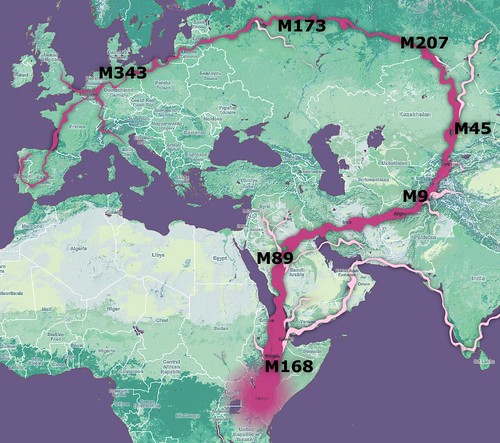
Once upon a time in the Stone Age -- about 60,000 years ago -- there lived a man who became the common ancestor of the vast majority of humans alive today. Since Christians believe that the name of the primogenitor of humanity was Adam, let's call this man the "
Eurasian Adam" (though he certainly wasn't the first "man" or even the only man alive at the time). He was, however, the progenitor of all non-African people; we know this is true because we all carry his genetic marker, known as
M168, in our DNA: indigenous Australians, Asians, Native Americans, and Europeans -- and most Africans as well. This "Eurasian Adam" lived in eastern Africa, where he fathered children and grandchildren, and it was his descendants who became the only lineage of humanity to endure outside of our home continent. In Europe and Asia, where Neandertals and
Homo erectus thrived for millennia but ultimately died out,
Homo sapiens would survive.
The first wave of modern humans emigrated from Africa soon after the
M168 genetic marker appeared. They likely followed a coastal route around the future Arabian peninsula, the Indian subcontinent and southeast Asia. Sea levels were much lower due to the ongoing
glacial period, and the channel between the land masses that would become Indonesia and Australia was only 90 kilometers wide; easily conquered by a nomadic people who had made their living along the maritime coast for a few centuries, or perhaps millennia. They crossed that gap and survived in their new homeland for 40,000 years, eventually to become known to western explorers as the indigenous Australians. These were not my ancestors.
Other descendants of the "Eurasian Adam" later migrated northward from their birthplace, probably following herds of animals moving in that direction during the temporary retreat of the glaciers that brought a moister climate to the African deserts. About 45,000 years ago, in northern Africa or the Middle East, one of these descendants fathered a male child with a different genetic marker,
M89: riding the crest of the second wave of migration out of Africa, he was to become the ancestor of about 92% of all non-Africans alive today. Within the next few thousand years the climate shifted again and the grasslands retreated, rendering the great desert to the south impassable once more. Some of
M89's descendants remained in the Near East; others migrated to the northwest, toward the Mediterranean; still others followed the animals that roamed ever north and east, to the steppes of Central Asia. Let us follow this latter group, because they are my ancestors, and probably yours as well.
The next branch in this family tree is a mighty one. Roughly 40,000 years ago, one of
M89's descendants was born with another genetic marker,
M9. This man, born in present-day Iran or south central Asia, was to be the ancient ancestor of almost all North Americans and East Asians, as well as most Europeans and many Indians. His descendants populated most of the northern hemisphere. Over the next few millennia, tens of thousands of people dispersed to the east and north. When they encountered the
Pamir Knot, the junction of four behemoth mountain ranges that is sometimes called "The Roof of the World", some moved south while others continued north, spawning new separate genetic lineages.
We will follow the line that went north into central Asia. Roughly 35,000 years ago, when there were approximately 100,000 human beings on the planet (not counting the Neandertals still living amongst the glaciers in present-day Europe) the next link in the chain appears:
M45. He lived in central Asia in the way of his ancestors, by gathering edible vegetation and by following and hunting the mammoth, bison, and antelope herds. But soon the climate shifted once more, and the expanding glaciers and reduction in rainfall may have forced the animals to abandon the southern steppes and push northward once again, with the humans trailing as always. The harsher climatic conditions may have helped spark new hunting techniques for the larger animals encountered in the north, and new technology like bone needles for sewing clothes made from animal skins. From here, some people went northeast -- this branch eventually settled east Asia, and included the ancestors of the small group who would migrate across Beringia and work their way south to become the natives of both North and South America. But my ancestors did not walk east.
The
M207 genetic marker appears in a man who lived roughly 30,000 years ago, as a branch of the Central Asian clan moved west. Soon afterward, another marker appeared in my bloodline,
M173. Some of his descendants would reverse their trajectory and descend southeast, some in due course making it all the way to the Indian subcontinent. But my ancestors forged ahead into Europe, part of the first wave of modern humans to do so, and survived to see the extinction of our hominid cousins, the Neandertals.
Homo neanderthalensis had been living in Europe for roughly a quarter million years, ages before our ancestors began their journey out of Africa. We did not evolve from them, but we shared a common ancestor some 500,000 years ago. They were intelligent, social hominids, and they exhibited altruism in caring for their young, sick, and elderly. They buried their dead in what some archeologists consider ritualistic fetal positions, which may be evidence for religious belief. They made tools and were well adapted to their environment, which was again changing; this time, however, they had competition.
The descendants of
M173, known to archeologists as the
Aurignacian culture, brought with them the technology they had developed in central Asia: tools and weapons made of stone, bone, ivory, antler, and shells. They carved figurines and wore jewelry, a possible indicator of status within the clan and a more complex society. They also possessed better techniques for communication, and they had the resourcefulness that had served them so well throughout their migrations. There was probably some form of contact between my ancestors and their much older European cousins, but there is no genetic evidence that interbreeding took place between the two species. Within the span of a few thousand years, the Neandertals were extinct.
At around this same time, one of
M173's descendants sired the last known link in this chain: the man carrying the genetic marker known as
M343, the defining marker of genetic
Haplogroup R1b, of which I am a member. My ancestors were once known as the
Cro-Magnon people, but today anthropologists prefer to call them
Early Modern Humans. They wove clothing, lived in huts, made and played primitive musical instruments, and painted
unprecedented depictions of wildlife in caves in southern France.
About 20,000 years ago, the
Last Glacial Maximum brought ice sheets again down into the British Isles and northern Europe; to avoid the oncoming glaciers, my ancestors moved south into the Iberian peninsula, Italy, and the Balkans. About ten thousand years later, the last glacial period ended, allowing
M343's descendants to repopulate northern Europe, where they thrived and eventually gave up hunting and gathering for agriculture and animal domestication. These innovations allowed for larger populations, and greater hierarchical differentiation within those populations. Clans and tribes became villages and towns. Over the course of thousands of years polytheistic religions took shape and were in turn displaced by southeastern monotheism; languages grew apart through geographical isolation; conquerers brought other foreign tongues; cities sprang up and were destroyed and rose again; in short, the beginning of recorded history was made.
Today, descendants of
M173 can be found all over western Europe, with concentrations highest in northern France and the British Isles, where the marker was carried after populations had hidden from the glaciers in Spain and Portugal. I share my own haplogroup,
R1b (defined by the presence of genetic marker
M343), with about 70 percent of men in southern England.
R1b is even more prevalent in parts of Spain, France, Scotland and Ireland, where it is carried by more than 90 percent of the male popuation. My family knows that my father's paternal heritage is American of northern European ancestry; when we delve back a few hundred years, however, the knowledge of our history dissolves into myth. We do not know for certain why my paternal ancestors left Europe for America, or even from which country they came. On which side did they fight in the Hundred Years' War? Were they aggressors or victims in the Norman invasion of England? On what chalky coast or in what verdant hinterland did they weather the Dark Ages and the Black Death? I'll never know the answers to these questions.
I find it astounding and humbling that the ancient origins of my forefathers, going back tens of thousands of years, can now be known with greater certainty than the relatively recent past. I am grateful to modern science for enriching my life and for telling me the story of my ancestors.
I wrote this blog entry with the aid of materials I printed out from The Genographic Project's website, and made the above graphic using Google Maps and
Shake. Click
here,
here, or
here to see the maps and test results of others who have submitted their DNA to the Genographic Project.